Packaging Waste Sorting Line Rebuilt for Speed, Purity, and Fire Safety
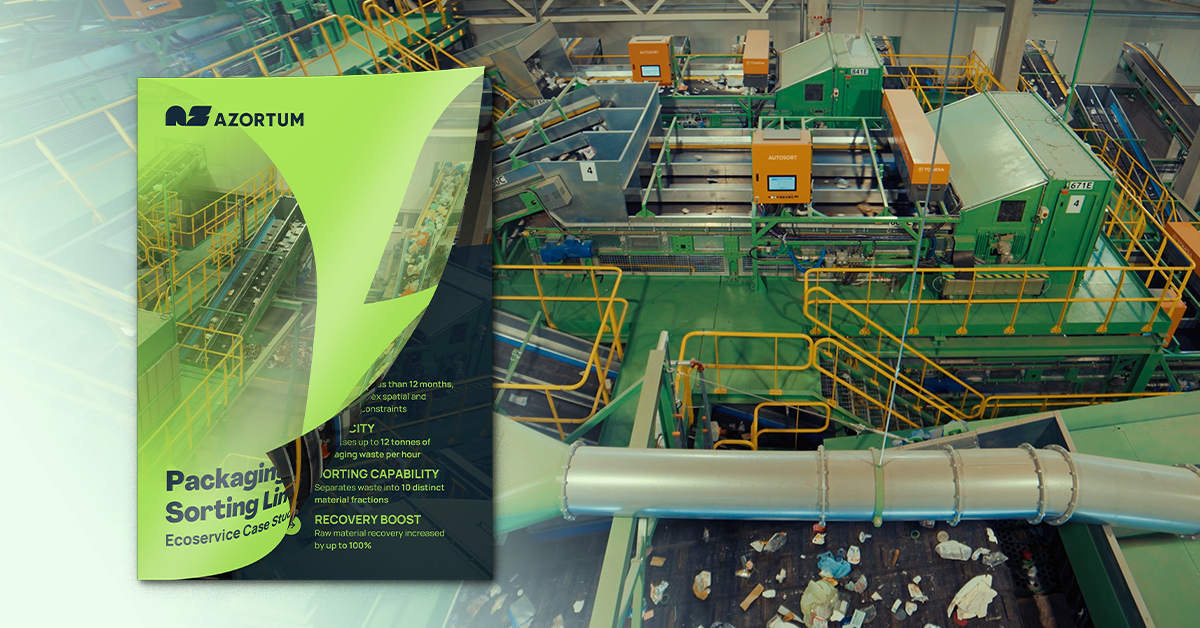
How Ecoservice rebuilt a critical packaging waste sorting operation in Vilnius in less than 12 months, achieving 12 t/h throughput, 10 clean output fractions, and up to 100% higher raw material recovery inside a fixed building envelope.
When Recycling Infrastructure Must Be Rebuilt Fast
In 2023, a devastating fire destroyed Ecoservice’s packaging waste sorting facility in Vilnius. For one of Lithuania’s leading waste management companies, this was not just a plant shutdown. It was a direct hit to local recycling capacity.
The objective was not simply to replace what had been lost. Ecoservice needed a new generation packaging waste sorting line with higher throughput, better automation, improved fire safety, and stronger material recovery performance. The new system also had to fit into the footprint of a building already under construction, without increasing the available height, width, or length.
That created a demanding engineering brief:
- restore critical sorting capacity on an aggressive schedule
- process up to 12 t/h of household packaging waste
- separate material into at least 10 valuable fractions
- minimise manual handling and improve operator oversight
- maximise purity and recovery while respecting fixed spatial constraints
For waste sorting plant managers and project developers, this is a familiar scenario: the process target is ambitious, but the civil envelope, construction schedule, and commissioning window are already locked.
Engineering Under Real-World Constraints
From the start, the project required construction, engineering, equipment delivery, and installation to run in parallel. In practical terms, that meant installing process equipment before parts of the building were fully complete. At one point, a drum screen had to be lowered through a partially finished roof with only centimetres to spare.
Azortum responded with a compact, high-capacity process layout engineered to use every available square metre efficiently. The line integrates core separation technologies into a continuous flow, including:
- drum screening
- optical sorting
- magnetic separation
- eddy current separation
- fire detection and suppression systems
- SCADA visualisation and process monitoring
This system architecture gave Ecoservice more than capacity. It delivered process visibility, better operational control, and a safer foundation for long-term performance under sustained load.
Results That Matter in Daily Operation
The finished plant gives Ecoservice a packaging waste sorting line built for both immediate performance and future recycling demands.
The result is a facility that:
- sorts packaging waste into 10 clean fractions
- increases operational efficiency threefold
- doubles raw material recovery while reducing manual handling
- supports reliable, continuous operation under heavy load
The line also generates a broad output portfolio that improves downstream material valorisation, including ferrous metal, non-ferrous metal, de-ink paper, paper mix, clear and mixed film, PP, HDPE, PET clear, PET mix, Tetra, PS, and RDF.
Most importantly, the project was completed and ready for testing in less than 12 months despite the complexity of the rebuild.
Partnership in Action
“Azortum listened to what we needed and came up with one of the best possible solutions. They provided great quality for the money.”
Andžej Juchevič, Technical Manager at Ecoservice
From the ashes of the old facility rose one of the most advanced packaging waste sorting lines in the Baltics — engineered to process more, recover more, and support Lithuania’s move toward a stronger circular economy.